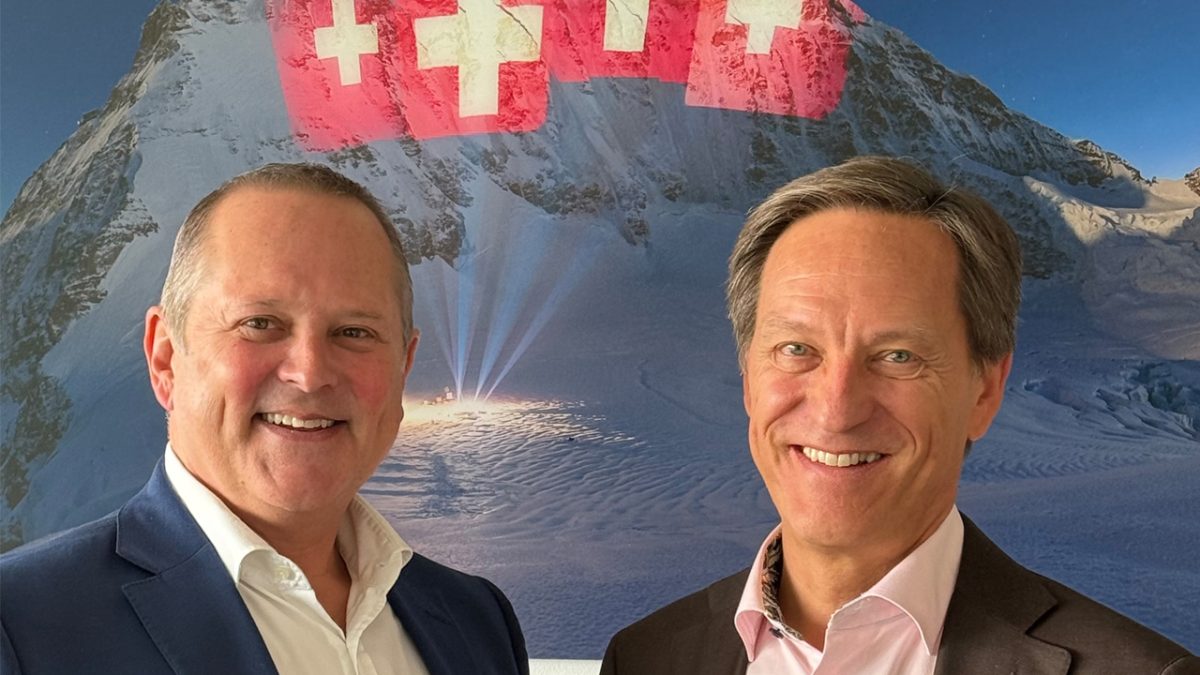

As one of the world’s leading equipment suppliers, BOBST has continually adapted to a changing industrial landscape. Over the last few months, the company has announced significant structural changes, culminating in a new Sales and Marketing Organisation (SMO). In this exclusive interview, Daniel Brunton has the chance to catch up with Jean-Pascal Bobst, to discuss the macro-economic pressures driving these transformations, the evolution from machine manufacturer to end-to-end partner, and his vision for BOBST up to 2030.
Let’s start with the recent evolution of the organisation at Bobst. Why did you feel the need to modify the Sales and Marketing organisation over the last few months, and how is the business shaped today?
If we look back quite a few years, we focused heavily in 2010 on dividing into dedicated business units to build strong service capabilities and machine streams across our four industry sectors of corrugated, folding carton, flexibles and labels. We wanted to develop our core technology business while increasing shared service capabilities cross-industry. We therefore had to establish a 100% dedicated business unit service, covering local capabilities, technical support, spare parts, and logistics across all technologies and industries.
It is well documented that some major industrial players in general industry often struggle to build a strong enough backbone when it comes to service. At Bobst, we are able to do it much better because we span four allied industries, which is a massive asset. Increasingly, brand owners operate across two or three packaging sectors. They want a partner who can discuss multiple packaging formats – whether it be folding carton, labels, or flexible packaging – rather than just selling a single machine stream.
Then came COVID in 2020/21, with the associated supply chain limitations, and more recently, escalating geopolitical events. Tariffs are now a reality. When you look at macro-economic factors – such as the lack of strategic direction or poor political decisions that end up damaging entire industries like automotive or chemicals in Europe – you realise that decisions made years ago dictate the reality we face today. Combined with national debts, changing capital costs, and the lack of structural competitiveness in parts of Europe, businesses cannot afford to stand still. We have to evolve every five to seven years to stay resilient.
Our new Sales and Marketing Organisation, which will be rolled out in phases throughout the coming months, moves us closer to regional markets – for example, China for China, and India for India – while aligning our technology, machine operations, and service operations more tightly around customer applications and relationships.
How are geopolitical events and macroeconomic pressures fundamentally changing the way we do business?
Every year we seem to face a major crisis – COVID, supply chain shocks, the war in Ukraine, flooding, cyberattacks, and shifting tariffs. Beyond the operational disruptions, the broader issue is competitiveness. Western Europe faces steep challenges regarding the cost of capital and public debt.
Meanwhile, the competitive landscape – especially coming out of China – has shifted drastically. The philosophy and cost structures in China are entirely different to how we operate in Europe. Chinese equipment manufacturers are pushing aggressive growth strategies backed by state support, keeping pricing low. When you look at the total cost of ownership, high interest rates, and expensive capital, converters are naturally recalculating their investments.
For machine builders in regions like Western Europe, the traditional good-margin, highly complex flagship machines are becoming harder to justify because customers simply cannot secure the return on investment over the first five to ten years under current financial and market uncertainty constraints. We have to adapt our product mix – such as highlighting workhorse models like our Vision and Nova series – to deliver efficiency and value that matches market realities.
Would it be fair to say you are trying to move away from being simply a machine manufacturer and evolving to be an end-to-end partner for your customers? How do you maintain and build these relationships when customers aren’t buying lots of new machines due to poor market conditions?
Absolutely. Machine technology continues to advance, with reduced setup times and increasingly automated workflows. What matters most to converters is net output, overall job-related productivity and total cost of ownership.
Because many converters are running 30, 40, or 50 different short-run jobs a day rather than running 24/7 on a handful of jobs, sheets-per-hour is secondary to setup efficiency. This is why Bobst has evolved toward a partnership model driven by data, connectivity (like Bobst Connect), and joint development. We want to integrate our software, maintenance scheduling, and job recipes directly into our customers’ operations.
When market conditions are tough and new machine investments slow down, OEMs need to balance costs and protect technical knowledge, while leaning heavily into loyalty, service, upgrades, and close collaboration. Consistency in service and pricing is critical. We are also looking closely at refurbishment and retrofitting, though the market demand for refurbishments has been somewhat slower than I originally anticipated. Ultimately, long-term trust and intimate joint development with customers are what sustain relationships through industry cycles.
How is Bobst approaching globalisation across its customer base, particularly given the stark differences between markets like Europe and Asia?
Globalisation today cannot be approached with a one-size-fits-all model. The requirements of the Chinese corrugated or folding carton market have almost nothing to do with Europe.
In China, the pace of adoption and the regulatory framework driven by government five-year plans create a very specific environment. Chinese markets are ready to leapfrog directly to advanced digital and automated solutions based on clear state-backed roadmaps. In contrast, Europe is currently bogged down by complex bureaucracy, regulatory shifting, and internal fragmentation.
By restructuring Bobst around regional hubs, we ensure that our teams are fully immersed in local applications and requirements. We must be close to the regional realities of our customers if we want to succeed.
As CEO, what scares you about the future of the packaging industry globally?
What concerns me most is the slow path of innovation and transformation across the supply chain. Everyone agrees on what needs to be done regarding sustainability and efficiency, but no one wants to make the first move because of the perceived risk of losing ground.
We also see immense pressure from short-termism, regulatory bureaucracy, and shifting political mandates – whether regarding environmental directives or packaging materials – where rules change repeatedly over a few years, leaving investments without clear commercial returns. Furthermore, finding and retaining skilled workers to run manufacturing operations is becoming increasingly difficult as younger generations gravitate away from hands-on industrial environments.
On a more positive note, what excites you about the future of the industry and Bobst’s vision toward 2030?
Packaging is a fantastic, essential market to be in – everything we consume comes in a box or a carton, a flexible pack and usually with a label, and creativity in terms of design has no end. Materials will continue to evolve, and artificial intelligence combined with data connectivity will radically streamline workflows and reduce delivery times.
For Bobst, our ambition for 2030 is centred on strengthening our regional proximity, deepening digital integration with our customers, and leveraging our massive install base. Success means efficiently managing macro-economic cycles, reshaping our footprint to emerge stronger, enhancing value for our shareholders, and establishing a robust baseline that makes us fully prepared for whatever comes after 2030. Technology changes fast, but at the end of the day, our greatest competitive edge remains our culture, our people, and our commitment to being a trusted partner.