

For the first time in its history, the World Packaging Organisation (WPO) positioned the global packaging industry at the epicentre of climate negotiations during COP30, reinforcing a message long echoed through the technical corridors of the industry, but only now earning diplomatic prominence: there is no credible strategy to reduce food loss and waste without placing packaging at the centre of the solution.
Representing members in 66 countries, WPO President, Luciana Pellegrino, addressed government delegates, NGOs, multilateral agencies, and private sector leaders during a high-level session at the Action on Food Hub, in partnership with UNIDO and the FSSC Foundation. Her core message was clear, objective and urgent – “Packaging is not just a product; it is a critical system that protects resources, preserves food, enables trade, and powers sustainable food systems.”
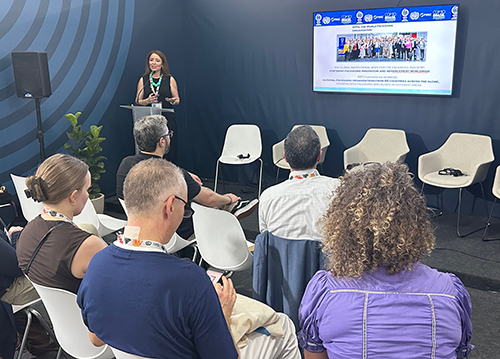
Luciana Pellegrino addressed government delegates, NGOs, multilateral agencies, and private sector leaders.
This milestone participation reflects a multi-year effort to raise the voice of packaging at the UN climate forum, an effort that matured into concrete influence at COP30.
Drawing from technical evidence, case studies, and WPO’s global initiatives, such as Navigating the Food Loss and Waste Paradox and the Design for Recycling Guidelines, Pellegrino emphasised how packaging innovation directly contributes to SDG 2, SDG 12, SDG 13, and SDG 17.
She also advanced the conversation beyond technology, delving into structural issues related to financing, public policy, and socio-economic impact. “Our next step is to expand the conversation into action: securing funding, increasing governmental support, and integrating packaging into public policies that strengthen sustainable food systems. The end goal is simple and transformative: to empower food chains and local communities with more efficient packaging thatpreserves products, reduces losses, and boosts economic resilience,” she said.
Pellegrino highlighted that small and mid-scale producers, particularly in emerging economies, are disproportionately affected by food loss due to inadequate storage, transportation, and protection systems. Packaging, when properly designed, can be the difference between losing half of the harvest or bringing it safely to market. Yet these producers rarely receive the technical attention or financing required to adopt better packaging.
For the global packaging community, the COP30 stage was more than a speaking slot; it was a recognition that the sector holds strategic influence in climate solutions. “What matters most is the commitment we are helping to build among governments, companies, and global institutions, to recognise the essential role of packaging in reducing food loss and empowering local food chains,” noted Pellegrino. “This is the beginning of a stronger movement. When packaging is properly valued and intelligently designed, entire communities benefit.”