

Tetra Pak has confirmed the final phase of a three-part 2025 investment programme to upgrade food and beverage carton sorting capabilities in the UK: the installation of AI-powered optical sorting technology for the first time in Scotland.
Tetra Pak has financed the production and installation of innovative AI-powered optical sorting technology at Levenseat Resource Management’s materials recycling facility (MRF) in Central Scotland, in collaboration with British technology start-up, Recycleye. The technology, known as Recycleye QuantiSort®, uses AI and cameras to detect beverage cartons within the mixed materials waste stream, and pneumatic valves are then used to eject them so that they can be sent on to be recycled.
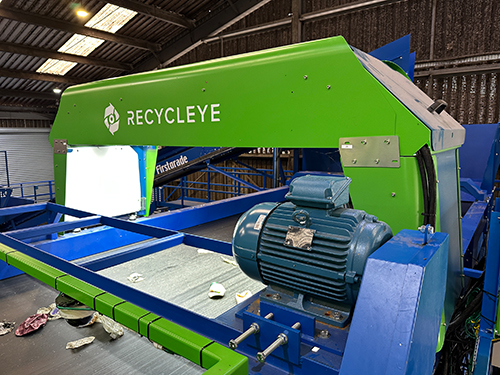
This upgrade will enable Levenseat Resource Management to enhance the sorting of food and beverage cartons for recycling. The company serves a large area, including Lanarkshire, Ayrshire and Dumbartonshire.
The announcement of funding for Levenseat follows two other upgrades at MRFs earlier in the year, bringing Tetra Pak’s total investment in UK sorting infrastructure in 2025 to £1.4 m. As the first site announced in May, J&B Recycling in Hartlepool received two new robotic sorting arms, also produced by Recycleye. In July, Cumbria Waste Management in Carlisle became the first site in the UK to use the Recycleye QuantiSort®, with the technology having previously been used at MRFs in Spain.
This work in the UK is part of Tetra Pak’s wider annual commitment of over £34m per year to expand food and beverage carton collection, sorting and recycling infrastructure globally, in collaboration with stakeholders across the value chain. Of this, £2.4m from Tetra Pak has been ringfenced specifically for infrastructure to sort food and beverage cartons in the UK.
This final round of Tetra Pak’s 2025 investment in sorting infrastructure marks a milestone in the company’s long-standing work collaborating with UK legislators and local authorities to improve the collection, sorting and recycling of food and beverage cartons.
“We are delighted to be able to demonstrate the power that investment in cutting-edge AI technology holds when it comes to improving the UK’s recycling infrastructure,” said Awantika Chadha, Sustainability Manager, Tetra Pak UK. “We are committed to supporting the transition to a circular economy in the UK, and will continue to advocate for our approach at Levenseat Resource Management, and elsewhere, to be seen as a blueprint for the future of food and beverage carton sorting capabilities both in Scotland and across the UK.”
“This first installation of the Recycleye QuantiSort® in Scotland is a major milestone for us. It has been a pleasure to collaborate with Tetra Pak and Levenseat Resource Management on this project, and more broadly on Tetra Pak’s mission to improve the bulk recovery of food and beverage cartons in the UK,” said Victor Dewulf, Co-founder and CEO, Recycleye. “AI has the capability to transform waste management, and we hope that our work with Levenseat and others will show MRFs and local authorities the possibilities this flexible technology offers.”
“We’re proud to work with Tetra Pak and Recycleye to bring AI-powered carton sorting technology to Scotland for the first time,” said Angus Hamilton, CEO, Levenseat Resource Management. “Strengthening our carton sorting capability means we can provide even greater value to the Local Authorities and communities we serve. Together, we are demonstrating how collaboration and innovation can make a real difference in building a more sustainable recycling system for Scotland and beyond.”
“With almost three quarters of UK councils now collecting liquid cartons at the kerbside, it is vital that there is investment in MRF infrastructure to ensure that cartons are being effectively sorted and sent for reprocessing,” said Mandy Kelly, Chief Executive, ACE UK. “I am proud that the carton industry has made a number of investments in key facilities across the UK, demonstrating effective carton sorting at scale. The installation at Levenseat marks another welcome step towards the widespread use of advanced sorting technology, with a clear focus on providing high-quality materials for reprocessing.”