

Drukarnia Tamir, a long-established Polish packaging producer with deep roots in conventional offset, is set to begin high-volume digital folding carton production with the Koenig & Bauer Durst VariJET 106 at the end of August, following installation and training. The move represents a significant strategic step for the family-owned company, which has built its business over more than 30 years on offset-based production of folding cartons, laminated corrugated packaging and leaflets. Founded in 1993 and now led by the second generation of the Krywulec family, Tamir serves customers in the pharmaceutical, cosmetics, food, automotive and appliances sectors across Poland and Europe.
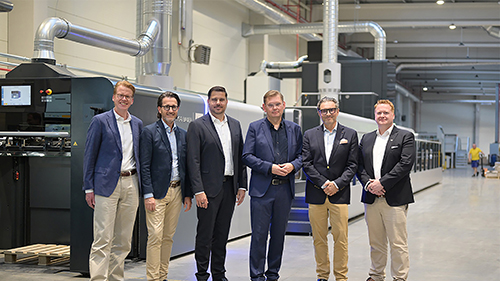
Left to right: Daniel Velema (Koenig & Bauer Durst), Markus Weiss (Koenig & Bauer Paper & Packaging Sheetfed Systems), Stephen Kimmich (Koenig & Bauer), Michal Krywulec (Drukarnia Tamir), Christoph Gamper (Durst Group), and Stefan Kappaun (Durst Group).
For a company coming from a purely offset environment, Tamir’s decision to move directly into industrial-scale digital folding carton production is an important statement – and further proof that digital is moving from discussion to implementation in mainstream packaging production.
At Tamir, the VariJET 106 is being introduced based on a clear short-run and medium-run business case. The hybrid press will replace older offset capacity for more than 3,600 short and medium-run jobs and over 5.6 million sheets annually. It is expected to enable production previously requiring two offset shifts to be handled in one VariJET shift.
The investment is forecast to generate significant annual waste savings and reduce production costs. In addition, the remaining VariJET 106 capacity is expected to relieve Tamir’s other nine offset presses from inefficient short- and medium-run work, further improving overall equipment efficiency and creating additional capacity across the pressroom.
“This is a significant strategic step for Tamir,” says Michal Krywulec, President of the Management Board, Tamir. “From the beginning, I had one key requirement: our digital press had to complement our offset production, not replace it. It had to be fully compatible with our existing workflow and, most importantly, capable of printing on the same carton substrates that we already use in offset production. This allows us to switch between technologies depending on the customer’s needs while maintaining the same quality standards and production flexibility.”
Krywulec continues, “When Koenig & Bauer Durst introduced the VariJET concept, it was the first solution that matched the vision I had for digital packaging production. It combines the flexibility of digital printing with the industrial capabilities and substrate compatibility we were looking for. That’s why we decided that VariJET was the right investment for Tamir. We come from a purely offset environment, so our decision to move into high-volume digital folding carton production was based on a clear business case and a view of how we want to develop our production in the future.”
He adds, “The VariJET 106 gives us the opportunity to handle short and medium runs more efficiently, improve flexibility across the entire pressroom, streamline production processes and optimise our cost structure. It also opens up new possibilities in areas such as variable data printing and allows us to respond more quickly when customers need urgent repeat work or short-run jobs. One example was a recent order for 70,000 folding cartons, where the customer later needed 250 additional boxes immediately. We were able to produce them quickly on the VariJET, without the two-hour setup time that offset would have required and with virtually no waste.”
For Koenig & Bauer Durst, Tamir is an important example of how established folding carton producers are adopting digital where it delivers measurable operational and economic value. Rather than positioning digital as a niche solution, the installation underlines how hybrid production can be integrated into real industrial environments to improve flexibility, efficiency and competitiveness.

