
While the packaging market is currently facing challenging times, Solidus looks to the future with confidence. Through strategic restructuring, the company has already strengthened its competitive position; and with the installation of two new Koenig & Bauer Rapida presses, Solidus is also taking a significant step forward in terms of efficiency and productivity.
With three in-house cardboard mills and ten converting facilities, Solidus is one of the leading players in the European market for solid board packaging. Jan-Willem Kleppers, VP Converting, is responsible for all converting locations, including those in Oude Pekela (Netherlands) and Hoogstraten(Belgium). “The quality standards for printing on solid board packaging are becoming increasingly demanding”, he explains. “At the same time, the portfolio is expanding as customers seek sustainable cardboard alternatives to plastic packaging. To respond to these trends, we are investing in our machinery.”
Printing on solid board places the utmost demands on printing presses, according to Kleppers. The material has a minimum weight of 500 gsm and can be up to 1.8 mm thick. “We were aiming for a very high and consistent output, even at a size of 120 x 164cm. Taken together, this represents a demanding set of specifications, even for Koenig & Bauer,” he says.
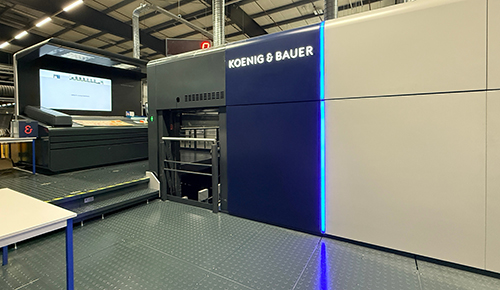
Solidus has opted for a Koenig & Bauer Rapida 164 for its Hoogstraten site and a Rapida 145 for its production facility in Oude Pekela. Kleppers continues, “The difference in format is due to the existing finishing machines at these sites. With the installation of a chemical-free ECO3 CtP system in Hoogstraten, everything is now perfectly coordinated.”
The two new machines are hybrid 6-colour presses (with varnish), which allows us to work with different types of ink. “For example, we often print on cardboard that has been made water-resistant using our Sapino process and has been coated. For that, we use UV inks. But we also produce packaging using conventional inks or special food-safe inks. These machines can handle it all,” says Kleppers.
The installation of the highly automated presses was an intensive process, during which the teams from Koenig & Bauer and Wifac worked closely with Solidus. “Technically speaking, we are pushing quite a few boundaries here: from non-stop feeding and fully automated logistics around the press, right through to dust extraction within the press and the specially adapted delivery,” he adds. “The arrival of the new machines also places demands on the press operators. We are taking a significant step forward in terms of speed and productivity. Our staff have been supported in this through training and development.”
The new presses not only deliver efficiency gains but also further standardisation of the production process. “The inline quality control on the press ensures optimum process stability. This allows us to start up more quickly with less material waste and guarantees consistent print quality,” concludes Kleppers.