The corrugated board packaging sector is at a pivotal moment. Several major trends are converging simultaneously, forcing converters to make critical decisions about the future of their businesses.
The market is becoming increasingly crowded, leading to tighter margins and more intense competition. At the same time, consumer expectations are evolving, prompting brand owners to seek new types of packaging solutions. Regulatory change is also gathering pace, with legislation such as the Packaging and Packaging Waste Regulation (PPWR) bringing mandatory sustainability targets into sharper focus. Meanwhile, the industry continues to face a shortage of skilled labour – a challenge that is set to intensify as a generation of experienced professionals approaches retirement.
Any one of these trends would demand a response. Taken together, they create a complex set of challenges that require converters to act in a strategic and decisive way.
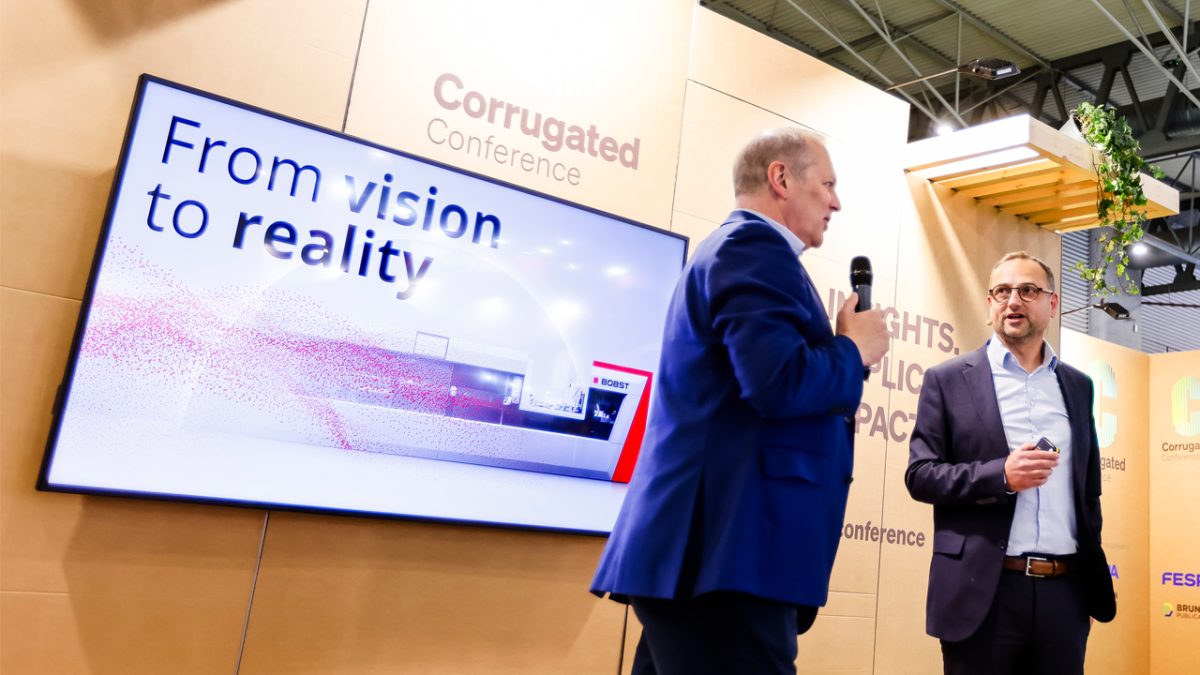
It was against this backdrop that the inaugural Corrugated 2026 event took place in Barcelona in May. Sponsored by BOBST and held alongside the FESPA Global Print Expo, the event offered visitors valuable insights into the future of the corrugated industry, while showcasing some of the solutions being developed to address its most pressing challenges.
At the heart of the event were three keynote presentations from BOBST on topics pertinent to the current environment: the opportunities that remain in e-commerce; the huge potential of robotics; and why digitalization is taking automation to the next level. A summary of all three sessions is below.
Could the e-commerce bubble burst? From Overcapacity to Opportunity: Rethinking the Future of Corrugated Packaging.
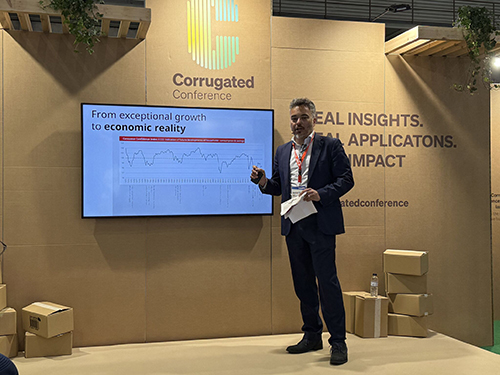
According to Christian Vionnet, Product Marketing Director for flatbed die-cutters and flexo post-printers, the real question is no longer whether e-commerce will continue to grow, but how converters can remain competitive in a market characterised by uncertainty, excess capacity and increasing complexity. He argued that the industry’s biggest challenge today stems from the unprecedented investment cycle that followed the pandemic. During the e-commerce boom of 2020–2021, converters and suppliers rapidly expanded production capacity to meet soaring demand. While that demand has since moderated, much of the capacity remains, creating a structural imbalance that is putting pressure on utilisation rates and margins.
At the same time, converters face a contradictory set of customer demands. Packaging is becoming more sophisticated, with growing expectations around premium unboxing experiences, traceability, product identification and multi-surface printing. Yet sustainability targets and cost pressures are simultaneously driving lightweighting and packaging simplification. Vionnet noted that future competitiveness will depend less on company size and more on a converter’s ability to adapt to these changing requirements. He identified four critical capabilities that will define successful operations: integration, agility, automation and precision. The industry’s focus, he argued, must shift towards reducing process steps, shortening changeovers, eliminating manual handling and achieving consistent quality.
Looking to the future, he stated that the future of corrugated packaging will be determined by manufacturing intelligence. As regulations such as the PPWR accelerate the drive towards lighter, more resource-efficient packaging, converters will need equipment and workflows that can adapt continuously to changing market realities. The winners will not necessarily be those with the largest factories, but those capable of producing smarter, lighter and more consistent packaging while maintaining profitability.
Find out more about how BOBST is boosting end-to-end efficiency in corrugated packaging here.
The huge potential of robotics in the corrugated board industry
Robotics is quickly moving from an emerging technology to a mainstream productivity tool within the corrugated sector. Jan Deschuytter, Technology Sales Manager, outlined Bobst’s vision for a fully integrated production environment in which robotic systems are connected throughout the converting process, from pre-feeding through to palletizing and final handling.
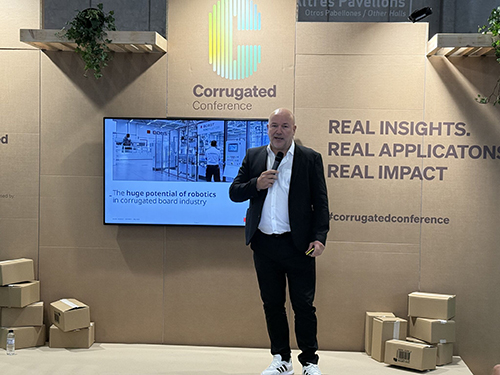
Bobst robotics are at either end of a completely automated line, from ROBOLOADER, an advanced robot that automates the transfer of blank piles, eliminating the need for any manual intervention at the feeder; to ROBOPALLETIZER automatically stacks piles or batches in multiple pallet configurations, fully automating the palletizing process.
In the near future, the entire line will be fully automated and connected and controlled through a single interface like Bobst Connect, simplifying operation and reducing setup complexity.
With skilled labour shortages one of the industry’s most pressing challenges, converters can benefit significantly from robotics. Based on examples presented during the session, facilities operating three shifts could realise annual labour savings of several hundred thousand euros, leading to payback periods of less than two years and, in some cases, under 12 months.
Deschuytter revealed that Bobst has already installed more than 450 robotic systems globally and is currently delivering around 50 new robotic solutions each year, with over 325 installations operating in Europe alone. These figures underline the fact that robotics is becoming an essential tool for addressing labor shortages, improving productivity and building more resilient operations.
Find out more about end-to-end lines powered by robotics here.
Automation in the modern corrugated box plant and the importance of digitalization
One particularly striking statistic in David Arnaud’s presentation was his estimate that converters are currently operating at approximately 80% capacity utilisation. In an environment where every order matters, including short runs and low-volume jobs, efficiency and flexibility have become more important than ever.
David Arnaud, Product Marketing Director for flexo folder-gluers and rotary die-cutters, argued that while automation is an essential aspect of corrugated packaging converting, it is no longer sufficient on its own. Traditional automation can execute tasks quickly and accurately, but it cannot identify shifts in board quality, retain the expertise of experienced operators or anticipate emerging bottlenecks. This is where digitalization becomes critical – “automation executes, digitalization reveals,” as he put it. Through digital systems, converters gain real-time visibility into machine performance, material variability, setup efficiency and quality trends. Digitalization also enables production recipes and process knowledge to be captured and shared, helping to address the industry’s growing skills gap as experienced operators retire.
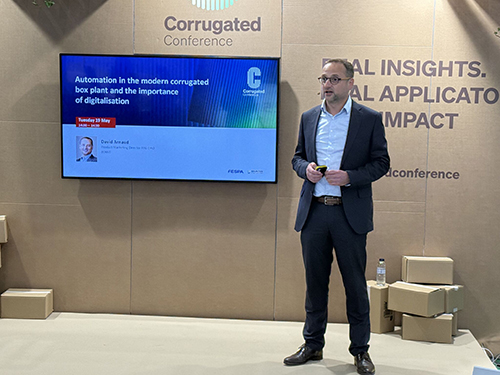
The presentation included several compelling examples of the measurable benefits digitalization can deliver. Advanced inspection systems like ACCUCHECK now make it possible to inspect 100% of boxes produced, reducing waste and helping prevent customer complaints. New-generation die-cutters can reduce energy consumption per unit produced by approximately 12%, supporting both cost reduction and sustainability goals. Meanwhile, innovations such as sequential order change technology can save around two minutes per setup. While seemingly modest, this can translate into approximately 3% more machine availability annually, creating meaningful improvements in productivity and revenue potential. Looking to the future, he sees connectivity as the next major step, enabling converters to move beyond individual machine optimisation towards fully connected operations where performance data, best practices and predictive insights can be shared across entire plants and networks.
Find out more about future of fully automated corrugated production here.
Conclusion
Together, these three perspectives illustrate the clear path forward for the corrugated industry. Converters are under increasing pressure to improve productivity, reduce costs, address labour shortages, and meet sustainability targets. By building smarter, fully connected production environments, converters can solve these challenges by connecting machines, workflows, people, and data into a single, intelligent production ecosystem.