
Investing in a high-speed folder-gluer is often viewed as the key to increasing production capacity. While modern folder-gluers are capable of running at extraordinary speeds, achieving those speeds consistently on the factory floor depends on much more than the machine itself. End-of-line packing operations frequently become the limiting factor, forcing manufacturers to slow down production long before reaching the folder-gluer’s true potential.
What if a packaging producer could install a new folder-gluer and immediately run it at the speeds it was designed to achieve? Not as a theoretical maximum, but as a measurable, day-to-day reality. That is exactly what Qualvis set out to accomplish. As growing customer demand pushed finishing capacity to its limits, the company invested in a new generation of high-speed folder-gluing technology. By pairing their new line with the right packing solution from day one, Qualvis was able to achieve production speeds exceeding 75,000 cartons per hour.
Reaching the full potential of a folder-gluer is not simply about buying faster equipment. It is about building a finishing line capable of sustaining those speeds in real-world production.
Built on Quality and Service — and Growing Fast
Qualvis has been producing folding cartons for the food and cosmetics sectors for decades.
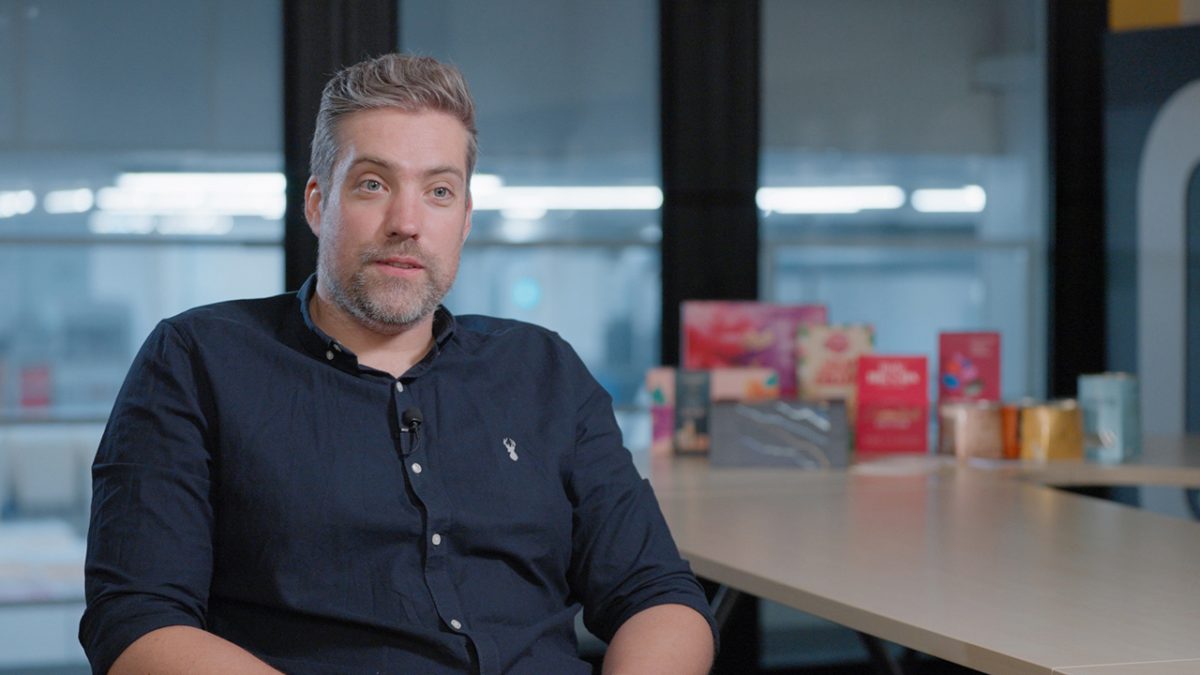
Marcus Short, Joint Managing Director, describes the company his father built from the ground up: a family business that carved out a deliberate niche serving customers who wanted something better than the high-volume, commoditised alternatives. “We’ve always concentrated on high quality. That’s where the name Qualvis actually comes from — it’s a mix between quality and service. That’s the ethos of the company,” he says.
That ethos has proven sustainable. Today, Qualvis has a workforce with an average service length of around 13 years. In the finishing team alone, four or five people have been there for over 30 years. Some of the children of those original employees now operate machinery on the factory floor.
When Long-Term Customers Outgrow the Line
Over the course of 20 years or more, several of Qualvis’s most loyal customers have grown significantly. Their packaging requirements evolved from the smaller, complex runs that originally brought them to Qualvis — and into high-volume, high-speed straight-line carton production.
“We have quite a few customers that have been with us for 20 years-plus. They’ve just grown organically with the business. Their volumes have now just increased and increased to a point where finishing has become the bottleneck — just through sheer volume of straight-line work,” explains Jordan Pugh, Head of Operations & Supply Chain. “We had to invest — because capacity had simply reached its limit.”
The decision was made: invest before capacity dictated terms. The senior management team discussed end-of-line options with IMPACK agent John Hall of iPack Solutions who introduced them to the ERGOSA packer.
Reaching the potential of the new folder-gluer
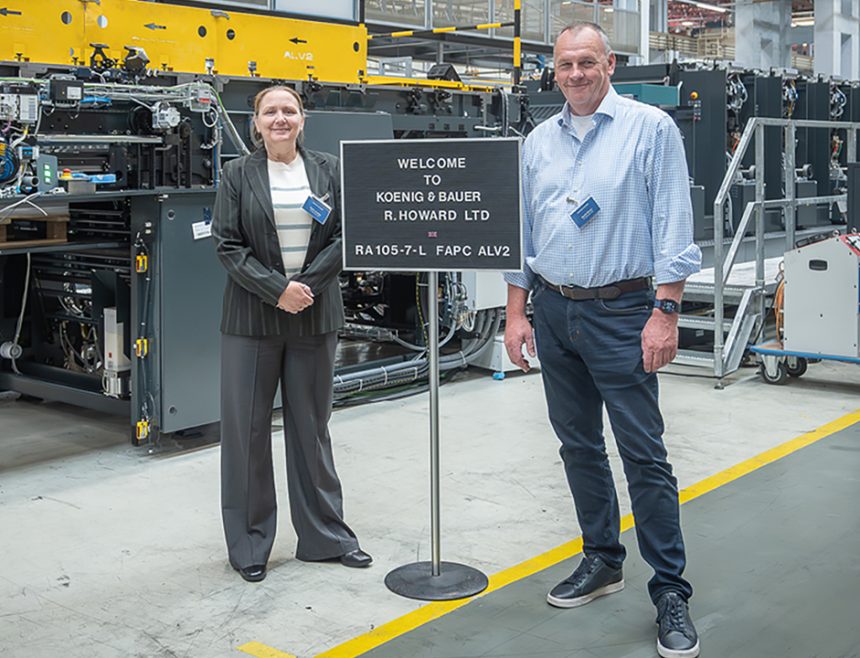
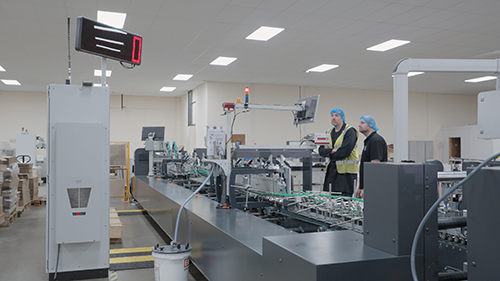
When Qualvis began evaluating folder-gluers, they were looking at several machines. During a visit to Koenig & Bauer to look at a printing press, they saw the answer to their straight-line production volume.
“We almost stumbled upon it by accident. We were there looking at a printing press. The finishing sales manager showed us a folder-gluer under development, showed us the capability, and right from the start it was: ‘that’s what we want, that’s what we need’,” continues Jordan Pugh.
Qualvis became the first global installation of the newly developed Koenig & Bauer straight-line-only folder-gluer built for volume and speed.
Hand packing at three times the speed
The previous packing method at Qualvis was manual with three people at the end of the gluer. One person managed the shingle stream, one erected cases and held the case flaps open, while the third person loaded cartons — picking up batches and twisting 90 degrees, repeatedly, for an entire shift.
Manual packing had already constrained production. At three times the speed, it would have made the new machine’s potential entirely unreachable.
“With this new machine, we’re going three times quicker. We won’t be able to keep up. We didn’t want to limit the speeds of the machine — so we had to make it easier for the employees at the end of the line,” adds Marcus Short.
A deliberate entry into automation
Qualvis evaluated fully automated packing options. It remains something they may pursue in the future. But for this investment — their first foray into automated end-of-line packing — a full jump to automation felt like too large a step without a reference point.
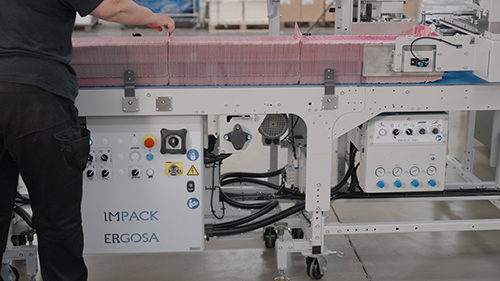
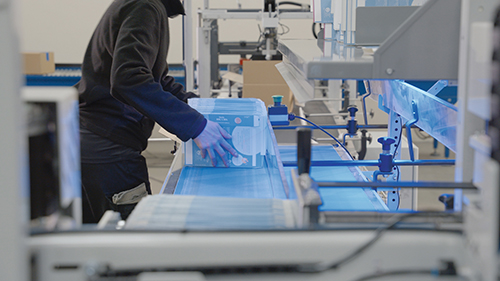
The Ergosa semi-automated packer offered a well-established middle ground: capable of supporting the speeds they needed, flexible enough for the product mix they run, and a manageable step change for a team that had only ever packed by hand.
“We were close to choosing fully automatic packing. But it’s quite a big leap from hand packing to going right into fully automatic. The Ergosa provides a very good middle ground while still giving us the option to run at very high speeds,” continues Jordan Pugh.
“The Ergosa has come with such great credentials. A lot of our competitors have used them. We looked at them in the past and it just seemed the right choice for the right time,” adds Marcus Short.
Flexibility built in from the start
Qualvis’ production environment requires flexibility. A single carton design can run for three or four days, or it can change three or four times a day. The Ergosa’s quick changeover and multi-configuration capability means it adapts to both scenarios without compromise.
While 95% of the work on the new line will likely be single-row, single-layer packing, the ability to run more complex case configurations when needed was a key selection criterion.
“Having the option for the 5%, to be able to do much more complex packing, is a real highlight,” says Jordan Pugh.
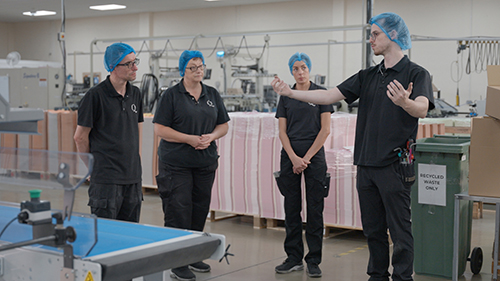
IMPACK engineer Raphaël Desmarais trains the Qualvis team on the new packing workflow.
Compact, clean, practical
Qualvis produces primarily food packaging, where a physical marker on the carton is not an acceptable solution for tracking reject product. The integrated INH box turner maintains the kick-out carton ensuring accurate batch counts.
Space was also a factor. The new folder-gluer is 29m long. Adding a packer at the end requires careful thought regarding the layout. The Ergosa INH configuration is more compact than alternatives, leaving room for case sealing before being routed to the palletisation zone.
“Even though we’re blessed with quite a lot of space compared to others, having the packer slightly shorter has definitely helped. We’re going to need more space to put work down there now — so having it as a more compact configuration has really allowed us to get that,” adds Jordan Pugh.
Speed, Ergonomics, and Operator Confidence
Qualvis set an internal benchmark of 60,000 cartons per hour across their five main lines. The Ergosa combination has already seen output reach 75,000 cartons per hour — and the line has demonstrated it can go further.
Real relief for the finishing team
The impact on the packing team has been immediate and visible. Operators no longer need to rotate or reach across the line. The physical workload is reduced; the rhythm of the work is more natural. For a company that retains staff for an average of 13 years and counts multi-generational families among its workforce, the ergonomic improvement is not just operational. It reflects the values Qualvis has built its culture on.
Operator adoption: Faster than expected
Packing by hand for years creates deeply embedded habits, but adoption has been faster than anticipated. Impack trainer Raphaël Desmarais delivered hands-on training, and was credited for the team’s confidence.
“The packing team has been excited about the investment. The trainer we’ve had on site has been really good — really welcoming. He’s helped the team adapt to the machine slowly and carefully, and that’s made a real difference. The vast majority have picked it up straight away. Even after a couple of days of training, they seemed very comfortable,” says Jordan Pugh.
The current plan is to maintain two operators on the end of the packer at high speeds — one managing carton transfer into the case and conducting quality checks and the other erecting cases and applying labels. At lower speeds, one operator will be sufficient.
What’s Next
Qualvis is clear that their automation journey is just beginning. The modular architecture of the Ergosa means that it can evolve with their production.
Watch the video documentary of this story here: